
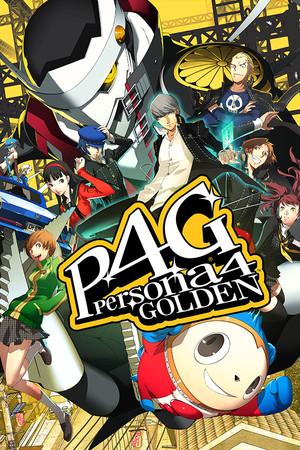
Persona 4 Golden
2020/Atlus
Persona 4, released outside Japan as Shin Megami Tensei: Persona 4, is a 2008 role-playing video game by Atlus. It is chronologically the fifth installment in the Persona series, and was released for the PlayStation 2 in Japan in July 2008, North America in December 2008, and in Europe and Australia in March 2009. It was one of the final major exclusives for the system. An enhanced version of the game, Persona 4 Golden, was released for PlayStation Vita in 2012 and received ports to Windows in 2020, and Nintendo Switch, PlayStation 4, Xbox One, and Xbox Series X/S in 2023.
Wikipedia · CC BY-SA 4.0 · shortened
About this game
Persona 4, released outside Japan as Shin Megami Tensei: Persona 4, is a 2008 role-playing video game by Atlus. It is chronologically the fifth installment in the Persona series, and was released for the PlayStation 2 in Japan in July 2008, North America in December 2008, and in Europe and Australia in March 2009. It was one of the final major exclusives for the system. An enhanced version of the game, Persona 4 Golden, was released for PlayStation Vita in 2012 and received ports to Windows in 2020, and Nintendo Switch, PlayStation 4, Xbox One, and Xbox Series X/S in 2023. A full remake of the game, Persona 4 Revival, will be released in February 2027 for PlayStation 5, Windows, Xbox Series X/S, and Nintendo Switch 2. The game takes place in a fictional Japanese countryside in 2011 as a player-named protagonist moves into the town of Inaba from the city for a year. During his year-long stay, he becomes involved in investigating mysterious murders with a group of friends while harnessing the power to summon physical manifestations of their psyches known as a Persona. Much like Persona 3 before it, the game features role-playing and simulation elements: the protagonist progresses through a cycle of days, explores dungeons while encountering enemies, and can forge relationships that can improve their Personas' strength in battle. The plot of Persona 4 was inspired by the work of mystery novelists owing to its murder mystery premise, primarily as a way of differentiating it from its predecessor. The rural setting was based on a town on the outskirts of Mount Fuji; it was intended to be a "'nowhere' place" and is the central setting to have players sympathize with the daily life of the characters. The developers added many in-game events to prevent the game from becoming stale. During localization, numerous alterations to Japanese cultural references were made to preserve the effect as much as possible. The release of Persona 4 in Japan was accompanied by merchandise such as character costumes and accessories. The game's music was primarily composed by series composer Shoji Meguro, with vocals performed by Shihoko Hirata. The Western releases came with a soundtrack CD with selected music from the game. The game received critical acclaim, with praise given to its gameplay, story, emotional depth, characters, and music. Golden received higher praise for its addition of new content and visual upgrades over the original. The latter, in addition to its numerous console ports in the early 2020s, sold around 2.5 million copies worldwide. In retrospect, Persona 4 is often considered to be one of the greatest video games ever made by several outlets. The game would see manga and light-novel adaptations, and an anime adaptation by AIC ASTA. The characters of Persona 4 have been featured in several spin-off games, including the fighting game Persona 4 Arena (2012), its sequel Persona 4 Arena Ultimax (2013), the rhythm game Persona 4: Dancing All Night (2015), and the Nintendo 3DS titles Persona Q: Shadow of the Labyrinth (2014) and Persona Q2: New Cinema Labyrinth (2018).
Text from the Wikipedia article “Persona 4: Golden” (en.wikipedia.org), shortened; available under CC BY-SA 4.0.
Trailer and screenshots
Image credits
- Cover: Steam · Steam Web API Terms of Use; artwork (c) its publisher
- Banner: Steam · Steam Web API Terms of Use; artwork (c) its publisher
- Screenshots (6): IGDB.com · Twitch Developer Services Agreement (IGDB); artwork (c) its publisher
Game data provided by IGDB.com